


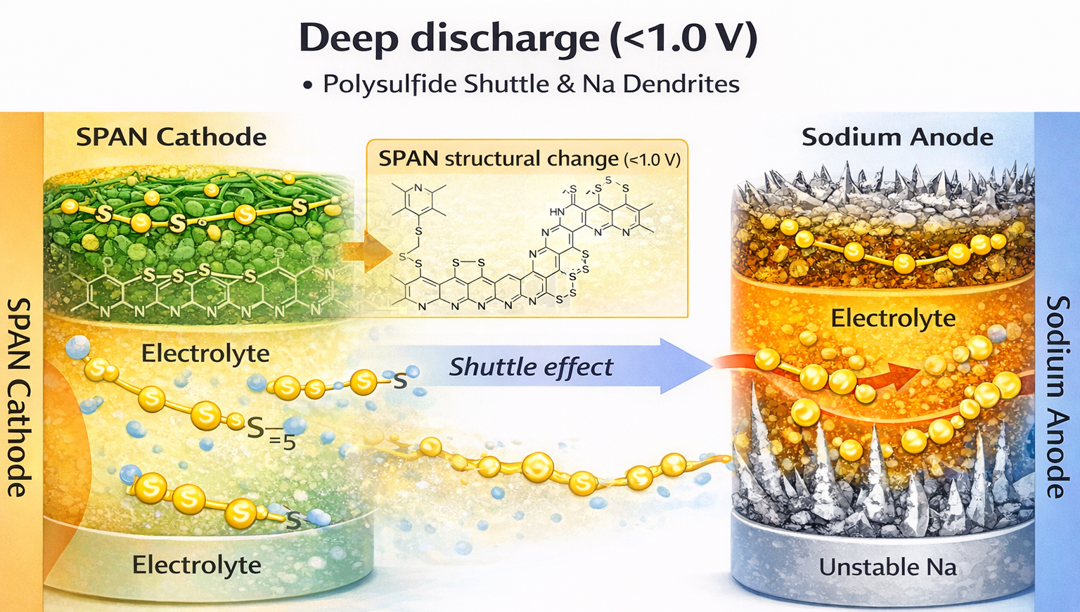
Sodium–sulfur (Na–S) batteries are promising for sustainable energy storage, but their performance is often limited by operational instability. In this study, we investigate sulfurized polyacrylonitrile (SPAN) as a cathode material and show that the depth of discharge plays a critical role in battery stability.
We find that deep discharge below 1.0 V causes structural changes in SPAN, leading to the formation of soluble polysulfides. These species migrate to the sodium anode, triggering side reactions, uneven sodium deposition, and dendrite growth. As a result, the battery experiences a loss of capacity and reduced lifespan.
By limiting the discharge range, these degradation processes can be minimized, preserving both the structure of the cathode and the overall performance of the battery. This work highlights the importance of optimizing operating conditions to achieve stable and efficient Na–S batteries.
Click here to read the full paper