




Key Sample Information:
- Sample Preparation
- Supported materials: Metals, polymers, adsorbed molecules…
- Formats: Bulk samples, thin films, fibers, powders
- Constraints:
-
Maximum size: 1.5 × 1.2 cm
-
Thickness: < 6 mm
-
-
Piezoelectric scanner: 5161EVLR
-
Scan range: 140 × 140 × 3 µm (X/Y/Z)
-
Detector: 4-quadrant photodiode
-
Resolution: Atomic resolution; Z-resolution in the sub-nanometer range
-
Accessibility: Self-service for staff and PhD students after training by the technical manager
-
Location: 3bis rue Alfred Werner
- Available Accessories:
- Liquid cell
- Heating stage
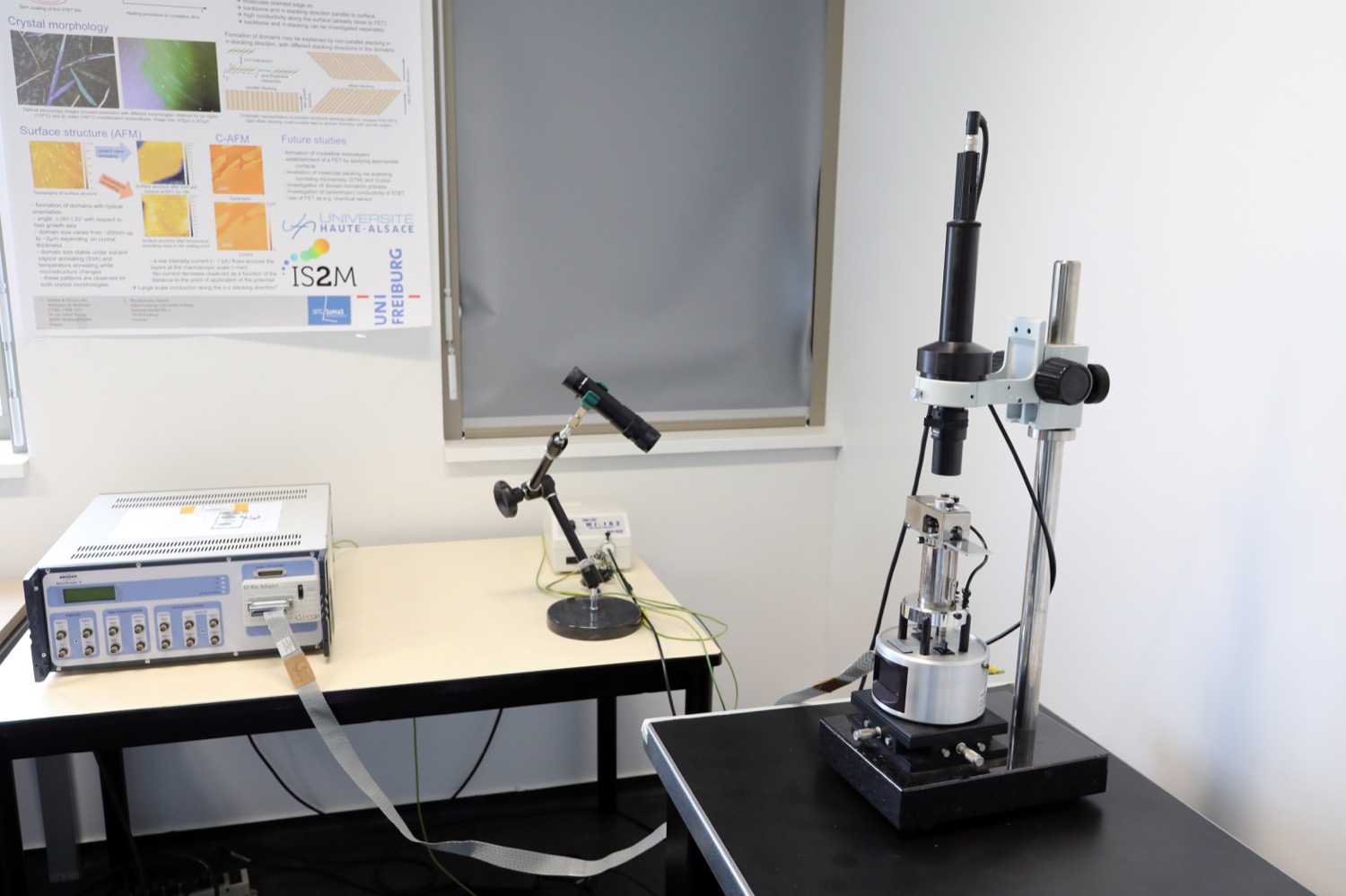
Atomic Force Microscope – NanoScope V
The NanoScope V allows ultra-high-resolution surface analysis in ambient conditions, liquid environments, or controlled atmospheres. It is suitable for a wide range of materials and offers multiple imaging modes, from simple topography to the characterization of electrostatic or magnetic forces.
What is it for ?
This microscope is used for:
- Nanometer-scale topographic imaging
- Surface mechanical interaction analysis (adhesion, friction)
- Investigation of local electrical and magnetic properties
Fields of application:
-
Materials science
-
Surface chemistry
-
Biology and biointerfaces
-
Nanotechnology
-
Characterization of polymers, thin films, fibers, powders, etc.
Available Measurement Types
Operating Modes
-
Contact mode:
-
Topography
-
Friction
-
Adhesion
-
Force modulation
-
-
Resonant modes:
-
Tapping mode
-
Phase contrast
-
KPFM (Kelvin Probe Force Microscopy)
-
EFM (Electrostatic Force Microscopy)
-
MFM (Magnetic Force Microscopy)
-
-
PeakForce QNM mode:
-
Quantitative mapping of nanomechanical properties (Young’s modulus, adhesion, deformation)
-
Operating Environments
-
Air
-
Liquid
-
Controlled atmosphere