




Key Sample Information
- Sample types: Powders (recommended), bulk samples possible in specific configurations
- Constraints: Height < 6 mm
- Atmospheres: Air, inert gases, oxygen (no reducing gases)
Technical Specifications
- X-ray tubes (anodes):
- Copper (λ = 1.54 Å)
- Chromium (λ = 2.29 Å)
- Goniometer:,Vertical, θ–2θ system
- Detectors:
- X’Celerator (fast detector)
- Proportional counter
- Monochromator: Germanium (111), removable, front-mounted
- High-temperature chamber:
- Anton Paar HTK1200
- Heating up to 1200°C
- Atmosphere control (oxygen, nitrogen, etc.)
Access
-
Partial self-service access:
-
Yes: Standard measurements after training by the technical manager
-
No: Configuration changes (geometry, detector, high-temperature chamber) require supervision
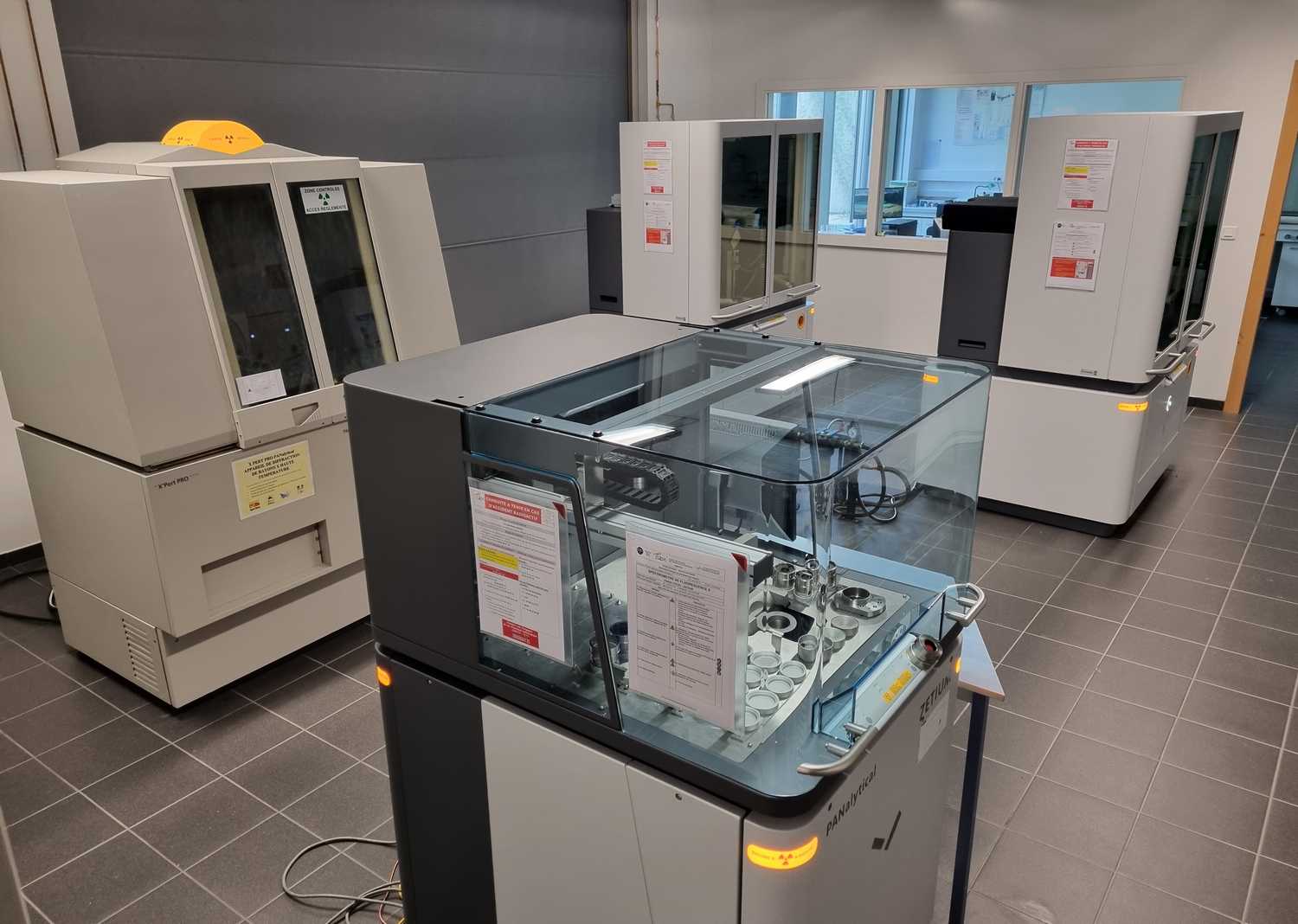
PANalytical X’Pert PRO MPD – X-ray Thermodiffraction System
The X’Pert PRO MPD is a versatile X-ray diffractometer designed for structural characterization of crystalline materials. Equipped with a high-temperature chamber and adaptable configurations, it enables in situ analysis of structural changes under thermal treatment and controlled atmospheres.
What is it for?
- The X’Pert PRO MPD is ideal for:
- In situ structural analysis during heating cycles
- Studying phase transitions and thermal stability of materials
- Monitoring oxidation, crystallization, or decomposition processes
- Characterizing materials under different environmental conditions
Application Areas
-
Phase transformation analysis (crystalline transitions, melting, oxidation)
-
Thermal stability studies of minerals, catalysts, crystalline polymers
-
Ceramics and metals under thermal treatment
-
Structural analysis under controlled atmospheres
-
Development of thermally-activated functional materials
Available Measurement Types
- Geometries:
- Reflection (Bragg-Brentano)
- Transmission (Debye-Scherrer)
- Angular range: 0.5° to 130° (2θ)
-
Angular resolution: Step size of 0.002° (2θ)
-
Temperature range: Up to 1200 °C using Anton Paar HTK1200 high-temperature chamber
-
Controlled atmospheres: Allowed (except reducing gases)