

Molecular Photochemistry and PhotoPolymerization
Molecular modelling (DFT), simulations, statistical data analysis (design of experiments and machine learning)

C. Dietlin, J. Lalevée, F. Morlet-Savary, M. Schmitt
The information on this page covers a range of machine-based methods that support all areas of research in our focus axis.
DFT and simulations (Contact : celine.dietlin@uha.fr)
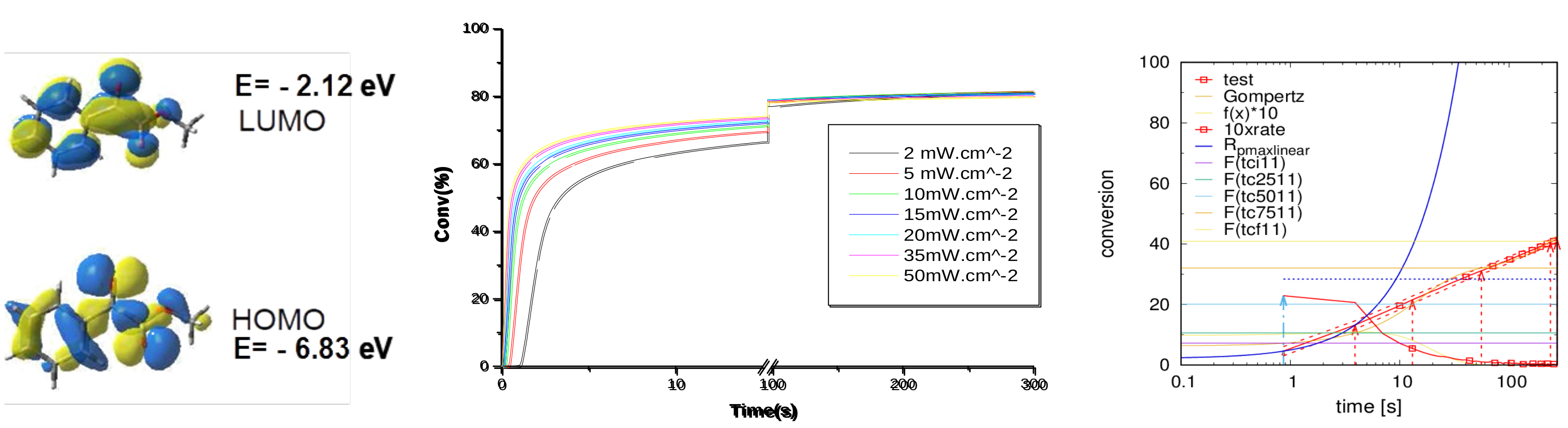
DFT methods (using Gaussian software) are used to predict or understand the behaviour of molecules, helping to select interesting molecules prior to synthesis, predict reaction mechanisms, etc. For example, bond dissociation energies, triplet energies, UV-vis spectra, orbitals, etc. can be calculated. Comsol is used to model the photopolymerisation reaction in order to optimise formulations and/or experimental conditions, thereby limiting the number of experiments required to optimise a chemical system.
Data processing and method development (Contact : michael.schmitt@uha.fr)
Faced with the advent of Industry 4.0 and the need to measure and analyse data in such a way as to ensure the highest possible statistical robustness and reproducibility, we are working on methods that enable, for example, the statistical analysis of mass polymerisation kinetics for FTIR or real-time solidification. We wish to extend our efforts to the use of pattern recognition procedures. One of the main challenges is to use pattern recognition with limited training data and chemical structures.
Publications
F. Hammoud, J. Kirschner, M. Carré, W. Paulus, A. Cristadoro, M. Schmitt, J. Lalevée, Assessment of Photoinduced Frontal Polymerization Processes for a Stable 1K System, Macromol Chem Phys, 224, 19, 2300237, (2023).
IS2M
Bâtiment CNRS
15, rue Jean Starcky - BP 2488
68057 Mulhouse cedex
Bâtiment IRJBD
3 bis, rue Alfred Werner
68093 Mulhouse cedex
tel: (+33)3 89 60 87 00
fax: (+33)3 89 60 87 99
