

 The European SuN4Med project (Sustainable and Novel Food Packaging based on Agro-industrial By-products and Natural Antimicrobials from the Mediterranean area) aims to develop biodegradable food packaging, reduce food waste, and valorize agro-industrial by-products.
The main objective is to reduce food waste by extending the shelf life of food through the development of biodegradable and antimicrobial food packaging.
Objectives and approach:
The project aims to mitigate food waste and plastic pollution by sorting agro-industrial residues using computer vision and artificial intelligence techniques.
It is aligned with the principles of the green and circular economy and uses green chemistry approaches, focusing on collaborative research and innovation activities among partners.
Specifically, SuN4Med explores the use of agro-industrial residues to formulate biopolymers intended for the development of biodegradable and antimicrobial packaging, replacing conventional food packaging plastics with biodegradable materials derived from agro-industrial by-products of various crops.
2.1 Why Sun4Med?
Context and scope
Every year, 4 billion tonnes of food are produced in the form of agro-industrial residues, of which one third is lost or wasted. Furthermore, food packaging generally uses petrochemical-based polymers which, although inexpensive, are not biodegradable and generate environmental problems, such as the formation of “plastic waste continents” in the oceans, affecting biodiversity and human health.
Raw materials used
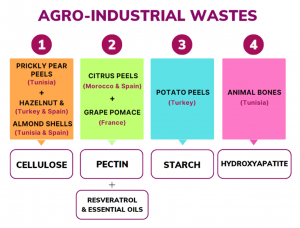
SuN4Med will replace conventional food packaging plastics with biodegradable materials, using agro-industrial by-products from various crops: hazelnut shells, prickly pears and almonds, citrus peels, grape pomace, potato peels, and even animal bone remains.
Timeline and quantified objectives
The work will run until 2028, involving collaborative research and innovation activities among the various partners.
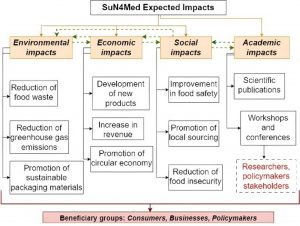
The objectives aim to replace 9% of conventional plastics with biodegradable materials by 2028, increase recycling rates, and reduce food insecurity in the Mediterranean region.
The project is part of efforts to reduce plastic waste and greenhouse gas emissions, and to lower the cost of raw materials, in line with the Sustainable Development Goals (SDGs).
2.2 Sun4Med Innovation
The SuN4Med project will make it possible to identify suitable antimicrobial additives derived from agro-industrial by-products. The extraction of at least two appropriate additives will be carried out in order to incorporate them into the formulation of new biobased polymer matrices. The new film and coating formulations will need to increase the shelf life of packaged food by at least 20%.
At least three different categories of traditional Mediterranean food will be packaged: citrus fruits, meat, and bakery products, and at least two processing techniques will be used: extrusion and dip coating. These new bioproducts will comply with European regulations to ensure that the new packaging materials are safe for consumers and meet the standards required for use in the food industry.
The manufacturing of bioactive packaging and coatings will be carried out using simple techniques such as:
(a) solvent casting (for films and coatings),
(b) compression molding, and
© extrusion.
The project will foster the development of innovative production methods to reduce the carbon footprint of packaging
production as well as save energy, while integrating innovative ICT solutions developed
by the Instituto Tecnológico de Castilla y León (ITCL) in Spain.
By developing sustainable and efficient packaging solutions, the project is taking a responsible approach
aimed at reducing waste and improving the efficiency of food supply chains at the local and regional levels.
2.3 Sun4Med Impact
Local by-products extracted from biobased food products originating from agriculture in Tunisia,
Morocco, Spain, France, and Turkey will be favored due to their agriculture-oriented economies.
Regions within these countries with low bioeconomic activity will be prioritized in order to promote
sustainable economic growth and to adopt a responsible approach ensuring long-term prosperity
in the Mediterranean region.
The SuN4Med project is composed of a consortium of 12 partners, including 8 academic partners, 3 industrial partners, and 1 technological center. Their expertise will cover everything from the identification of by-products, through extraction and purification, to the manufacturing of biobased polymer films and packaging. This new activity is expected to create new jobs with equal opportunities across genders.
A smart specialization strategy will be implemented by connecting stakeholders from the quadruple helix (authorities, SMEs, NGOs, and universities) around the valorization of Mediterranean agro-industrial waste rich in relevant biobased compounds for the production of biodegradable active packaging. This approach will help ensure that all relevant stakeholders are involved in the project and that the project’s outcomes are aligned with their needs and priorities. By leveraging a wide range of expertise, promoting gender equality within the workforce, and involving all relevant stakeholders in the project, this approach reflects a responsible commitment to ensuring long-term prosperity in the region.
Timeline:
Project launched on 30/06/2024 and scheduled to run until 30/06/2027, funded under the Euro-Mediterranean research initiatives (PRIMA).
The consortium of the European SuN4Med project brings together 12 partners (8 academic and 4 industrial) from countries of the Mediterranean basin (France, Spain, Italy, Tunisia, Morocco, Germany).
Coordinated by Prof. Manuel Rendueles de la Vega, it is structured around cross-cutting scientific expertise.
Key academic partners
LAGEPP (Claude Bernard Lyon 1 University, France): Expert in process engineering and pharmaceutical formulation.
IS2M – CNRS (Mulhouse, France): Specialist in materials and surface science.
ITCL – Instituto Tecnológico de Castilla-León (Spain): Key technological center for technical development.
University of Oviedo (Spain): Focused on materials analysis and transformation.
University of Würzburg (Germany): Support in fundamental research and chemistry.
Cadi Ayyad University (Morocco): Expertise on the resources of the Mediterranean eco-region.
ENIS (University of Sfax) & ISSAT (University of Gabès) (Tunisia): Laboratories specialized in process engineering and innovative materials.
Key industrial partners
Aptar CSP Technologies (France): Leader in active packaging and product protection solutions.
Iberfruta Muerza S.A. (Spain): Agri-food group supplying the raw material (fruit co-products).
The specific types of biopolymers used
The project’s innovation is based on versatile biocomposites formulated by combining several biobased matrices:
Modified cellulose: Extracted directly from prickly pear peels as well as hazelnut and almond shells. It strengthens the mechanical properties of the packaging.
Modified starch: Derived from potato peels recovered from the processing industry.
Modified pectin: Extracted from citrus peels and grape pomace. It acts as an excellent binding agent and protective barrier.
The green chemistry method adopted
The core method developed by LAGEPP consists of extracting and purifying resveratrol and other antioxidant polyphenols from grape pomace.
Eco-solvents and low-energy processes: Abandoning traditional toxic organic solvents in favor of green solvents (such as water or biobased ethanol) combined with low energy consumption processes.
Advanced extraction technologies: Use of assisted extraction (ultrasound- or microwave-assisted) as well as deep eutectic solvents (DES) to cleanly break down plant cells.
Active encapsulation: The purified resveratrol is then encapsulated at the molecular scale to be homogeneously incorporated into the biodegradable plastic film. It is thus released in a controlled manner to destroy bacteria and extend the freshness of food.
up to come
up to come
IS2M
Bâtiment CNRS
15, rue Jean Starcky - BP 2488
68057 Mulhouse cedex
Bâtiment IRJBD
3 bis, rue Alfred Werner
68093 Mulhouse cedex
tel: (+33)3 89 60 87 00
fax: (+33)3 89 60 87 99
