


Perovskite Materials for Photovoltaics: Understanding to Improve Stability
Perovskite Materials for Photovoltaics: Understanding to Improve Stability
J. Hieulle, M. Hamieh, J. L. Bubendorf, M. Cranney, D. Aubel, E. Denys, A. Florentin, F. Vonau and L. Simon
Contact: jeremy.hieulle@uha.fr, laurent.simon@uha.fr
Halide perovskites have emerged as a new generation of semiconductor materials capable of converting sunlight into electricity with power conversion efficiencies now comparable to those of crystalline silicon. Their low fabrication cost and outstanding optoelectronic properties make them highly promising candidates for next-generation solar cells (Figure 1a). However, their widespread commercialization is still hindered by limited long-term stability. Under continuous exposure to light, heat, or moisture, perovskite materials gradually degrade, leading to a loss of device performance. Our research aims to understand these fundamental degradation mechanisms by investigating the atomic structure of perovskites and the evolution of their electronic properties using state-of-the-art characterization techniques, including Scanning Tunneling Microscopy (STM), Atomic Force Microscopy (AFM), X-ray Photoelectron Spectroscopy (XPS), and correlative microscopy combining Scanning Electron Microscopy (SEM), Cathodoluminescence (CL), Photoluminescence (PL), and Raman spectroscopy.
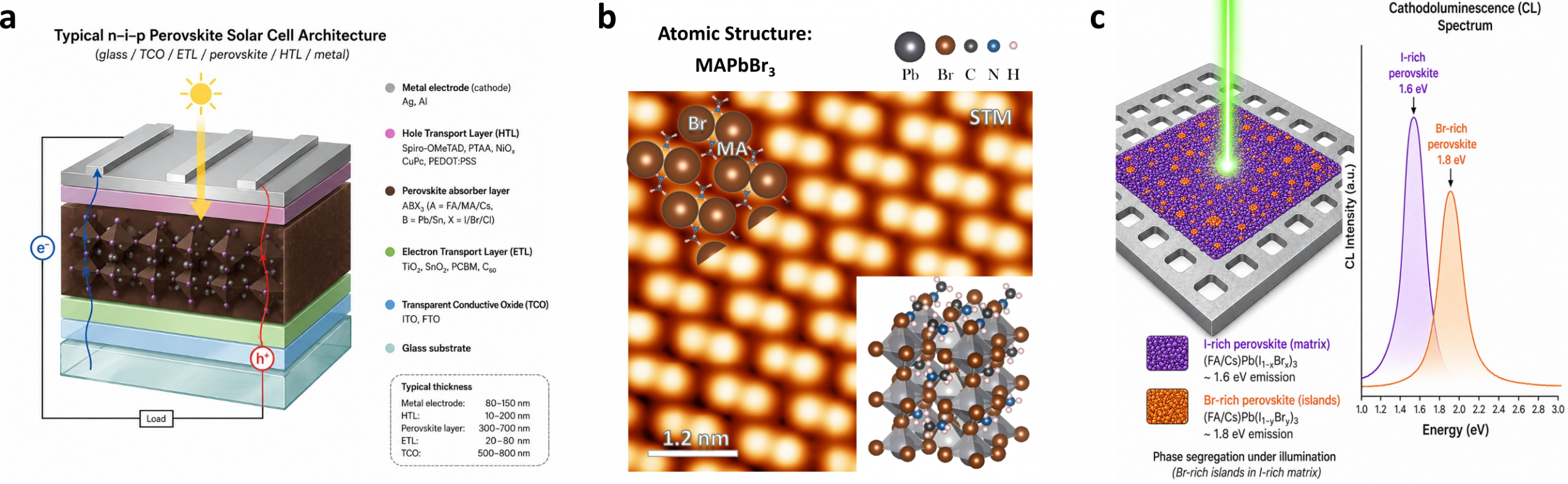
a) Perovskite Solar Cell Architecture. b) Surface Atomic Structure of MAPbBr3. c) Phase segregation and light-induced degradation of Perovskite measured by Cathodoluminescence.
Scanning Tunneling Microscopy (STM) enables us to determine the atomic structure of perovskite surfaces and directly visualize atomic-scale defects (Figure 1b). X-ray Photoelectron Spectroscopy (XPS) is employed to monitor light-induced chemical transformations in real time and to quantify the kinetics of perovskite degradation. Finally, we combine Scanning Electron Microscopy (SEM) with Cathodoluminescence (CL) in a correlative microscopy approach to investigate photo-induced degradation and phase segregation in mixed-halide perovskites, particularly the formation of bromine-rich (Br-rich) and iodine-rich (I-rich) domains (Figure 1c). By correlating structural, chemical, and optoelectronic information across multiple length scales, our work provides new insights into ion migration, defect formation, and degradation pathways, paving the way for the development of more stable and efficient perovskite solar cells.
Publications
IS2M
Bâtiment CNRS
15, rue Jean Starcky - BP 2488
68057 Mulhouse cedex
Bâtiment IRJBD
3 bis, rue Alfred Werner
68093 Mulhouse cedex
tel: (+33)3 89 60 87 00
fax: (+33)3 89 60 87 99
